
Chemical purification: filtering, evaporation and purity
Read chemical mixtures, remove the right impurities, use both evaporator slots, and compare Chem Finisher upgrades and product purity grades in Probably Stolen.
1.0
Version history
- 1.0 Main guide
Selective filtration, reagent treatment, evaporator recovery and all finishing purity thresholds.
Prepare the tools and read the mixture
Bring a Composition Spectrometer, clean liquid containers, a Water Pitcher with a filter slot, filter material, an Evaporator with a charged power source, and a Chem Finisher. Use a measuring tool to add reagents in small amounts. Equipment and Chemical Supplies purchases are covered in the chemistry starter guide.
Use the spectrometer on the source container. Read each component’s volume and percentage. The water-quality label on a chemical bottle describes its water content; check the actual active ingredient for the product you intend to make.
Scan purchased reagent bottles too. Acid, base, reducing agent and Lipobond bottles start with 2–8% mixed impurities. Adding a whole bottle can introduce more unwanted material than the treatment removes. Unpack owned  Chemical Supplies (Common) for acid, base and Lipobond; Chemical Supplies (Restricted) provide reducing agent and N-Methylol Base.
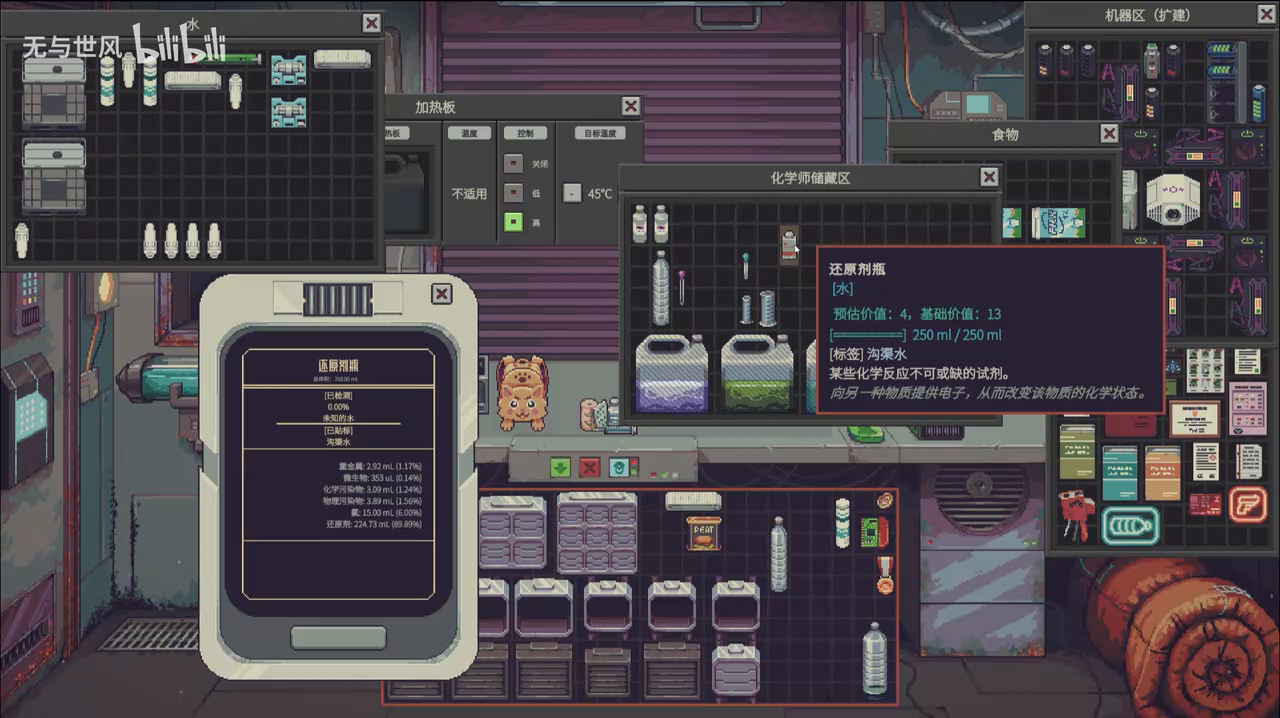
Extract the useful ingredient before filtering
Plant mush and plant extract are different components. Filters catch Coffee Bean Mush and Dream Cap Mush, while the extracted active ingredients pass through. Finish extraction before pouring the batch through a filter.
| Starting material | Extraction conditions | What to watch |
|---|---|---|
| Dream Cap Mush | Alcohol and 40–50°C | The mush degrades above 50°C; Dream Cap Extract starts degrading above 60°C. |
| Coffee Bean Mush with alcohol | At least 50°C | Alcohol extraction gives more caffeine than the water route; follow the spectrometer until the mush is processed. |
| Coffee Bean Mush with water | At least 80°C | This route has a lower extraction yield. |
A stock Heating Plate targets 99°C; one Chemical Equipment Module changes that to 160°C. Two modules unlock temperature controls. Check the actual temperature while heating a sensitive batch, then remove it when the intended reaction has finished. The original recipes are in the Chemistry 101 Guide.
Pour into the jug that holds the filter
Install the filter in the receiving Water Pitcher, then pour the mixture into that pitcher. Cloth left in the source container does not filter liquid being poured out. The filter-fitting instructions show the slot and transfer operation.
| Filter | Components it removes | Components it leaves |
|---|---|---|
 Kotton Fabric |
Plant mush, plant matter and Insoluble Debris | Minerals, Physical Contaminants and dissolved ingredients |
 Water Filter |
The coarse material above, plus Organic Waste, Microplastics, Minerals and Physical Contaminants | Active ingredients, protein, fat, starch, sugar, acid, base, reducing agent, stabilizer, Heavy Metals and Chemical Contaminants |
 Advanced Water Filter |
The same components as a Water Filter | The same dissolved ingredients; it restores 50 durability each cycle rather than filtering finer material |
Microbes pass through all these mechanical filters. Used filter durability limits how much a batch can lose. If catchable material remains, inspect the filter, replace it when worn out and pour through a clean receiving jug again. Keep room for the incoming mixture.
Avoid the HydraTech Micro Water Purifier for drug mixtures: it targets 98% water by removing non-water components, including the active ingredient you are trying to keep.
Match the treatment to the remaining impurity
After the first scan, add only the treatment required by the remaining components. Let the reaction change the mixture, scan it again, then filter any newly formed Insoluble Debris.
| Remaining component | Treatment | Result to check |
|---|---|---|
| Protein | Add acid or base | Protein and the excess acid or base react in equal volumes to make filterable debris. |
| Fat | Add Lipobond Agent | One part of Lipobond can bind eight parts of fat. Filter the resulting debris. |
| Leftover acid or base | Add the opposite reagent in small measured amounts | Equal volumes neutralize each other. Stop when the unwanted component is gone. |
| Stabilizing Agent | Treat with acid or base | Stabilizer becomes debris. Rescan the leftover reagent before adding more; its consumption is not a simple one-to-one dose. |
| Organic Waste | Filter directly, or treat with acid/base and then filter | Chemical treatment produces Minerals, which the Water Filter can remove. |
| Microbes | Use a  UV Lamp on the liquid container |
UV converts microbes to water and avoids heating a sensitive extract. |
| Heavy Metals, Chemical Contaminants | Inspect the starting material and each added reagent | Mechanical filtering leaves these components. Acid/base treatment and evaporation do not remove Heavy Metals. With water present, chlorine can reduce Chemical Contaminants to a 0.7% treatment threshold. |
| Actual starch or sugar | Change the source material or batch | Current mechanical filters, acid/base reactions and evaporation leave them in the mixture. |
If your aim is to purify acid or base as a reagent, keep that component. Neutralization consumes it. Evaporation can remove water and alcohol from the bottle, but its other nonvolatile impurities remain. Follow the before-and-after composition instead of the bottle name.
Dry the product in the main evaporator container
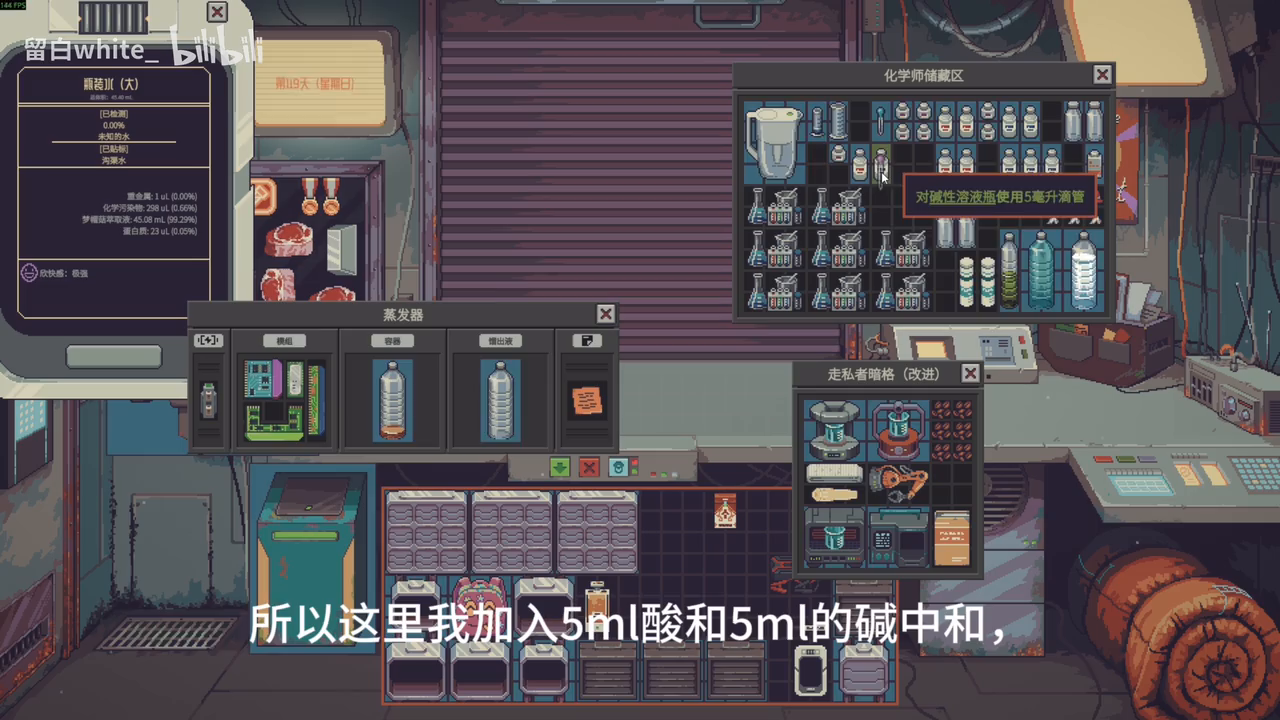
Put the prepared mixture in the Evaporator’s Container slot, fit a charged power source and end the day. A stock machine uses 6 energy to remove up to 300mL per night, shared proportionally among water, alcohol and Lipobond. Performance changes the amount; check the machine’s current energy cost after upgrades.
The useful nonvolatile material stays in the main container. Take that container to the Chem Finisher. Acid, base, protein, starch and other nonvolatile impurities stay there too, so drying alone does not complete their cleanup.
The Distillate slot collects recovered volatile liquid. Its recovery percentage comes from the machine’s Quality bonus, from 0% to 100%; the stock recovery rate is 0%. The Evaporator Solvent Recovery Module adds 50 Quality and restricts collection to alcohol. Water and Lipobond still leave the main mixture. An absent or full collection container lets the uncollected liquid escape.
For recovery, fit a spare container with enough room. For the product, inspect the main container in the morning. Leave heat-sensitive mixtures off the Heating Plate overnight.
Select the product and check its input
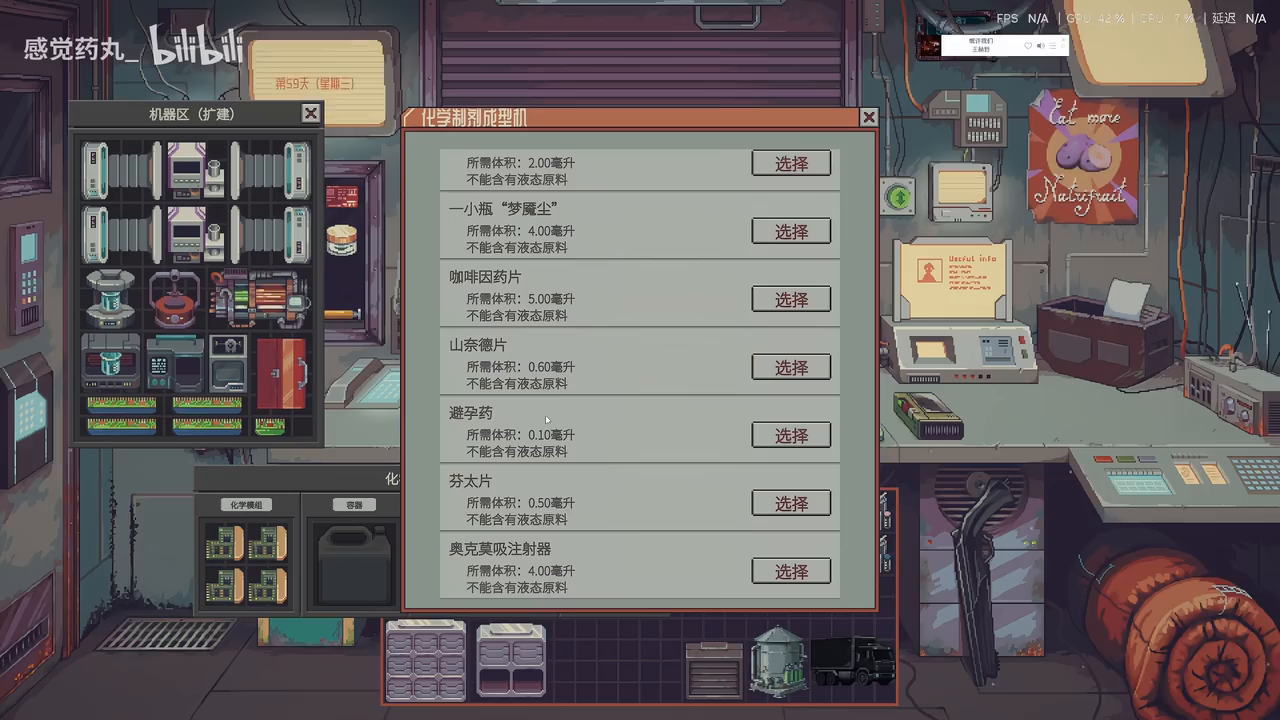
All seven recipes require water, alcohol and Lipobond to total at most 0.1mL. The volume below is the whole mixture consumed per item, not a minimum amount of its active ingredient.
| Selected product | Total mixture per item | Required active ingredient for purity |
|---|---|---|
| Vial of “Dream Dust” | 2mL | Dream Cap Extract |
| Vial of “Nightmare Dust” | 4mL | Nightmare Extract |
| Caffeine Pill | 5mL | Caffeine |
| Zyanide Pill | 0.6mL | Zyanide |
| Birth Control Pill | 0.1mL | Contraceptive |
| Phanta Pill | 0.5mL | Phanta |
| Nomore Injector | 4mL | Nomore |
Scan the input against the last column, select the matching recipe and leave output space. When the status reads Ready, press Output. This status confirms the volume and dryness checks. A batch without the selected active ingredient can still pass them; its composition determines the product purity.
Compare purity grades and finishing upgrades
The Chem Finisher introduces Physical Contaminants according to its installed  Chemical Equipment Modules. Upgrades reduce this added contamination; they do not clean the input mixture.
| Chemical modules in the finisher | Mixture replaced by contamination | Upper purity with ideal pure input |
|---|---|---|
| 0 | 12% | 88% |
| 1 | 6% | 94% |
| 2 | 3% | 97% |
| 3 | 1% | 99% |
| 4 | 0% | 100% |
For example, 5mL of dry caffeine mixture at 90% contains 4.5mL caffeine. A stock finisher leaves 3.96mL caffeine in the pill, giving 79.2%. Four modules preserve approximately the original 90%. Use this calculation to distinguish a dirty input from finishing losses.
| Product purity | Grade | Purity price modifier |
|---|---|---|
| 99% or more | Lab Pure | +135% |
| 90% to below 99% | Pharma-Grade | +85% |
| 80% to below 90% | Near Pharma | +40% |
| 60% to below 80% | Street Standard | 0% |
| 45% to below 60% | Cut Product | −45% |
| 30% to below 45% | Junk Grade | −75% |
| Below 30% | Starch Grade | −95% |
Starch Grade is a purity label, not a diagnosis that the mixture contains starch. Read the ingredient list to distinguish the two. The price modifier is the product’s purity adjustment; the item and transaction also affect the offer.
Scan a finished item before producing the rest of the batch. If the active ingredient is absent, correct the extraction or recipe choice. If other components dominate, return to the treatment table. If the clean input loses purity only during finishing, use the module table to choose the next upgrade.
Work a batch from pulp to finished product
For a first batch, choose Dream Dust or caffeine tablets and keep one labelled container per batch. Blend the matching mushroom or coffee beans, scan the collected pulp, then measure solvent from the pulp volume. The handbook’s 3–6 × starting range means 156 mL pulp takes 468–936 mL alcohol. That is alcohol content, not necessarily the total volume of a diluted drink; scan the solvent too.
| Product | Extraction and finishing |
|---|---|
| Dream Dust | Hold the alcohol mixture around 40–50°C, preferably 45°C. Above 50°C pulp starts degrading, above 60°C the extract also degrades. Wait for pulp to convert, then remove from heat. |
| Caffeine tablets | Alcohol extraction begins at 50°C; water extraction at 80°C. Alcohol gives a higher extraction yield. Scan until the pulp has reacted. |
A bare heating plate targets 99°C, one chemical upgrade targets 160°C; two unlock target control. For a heat-sensitive batch, set 45°C with control or remove the container as it warms through that range. Leaving it on a bare plate will keep heating it.
Filter only after extraction, treat the remaining impurities as above, then evaporate. Count nights from the measured water/alcohol/fat-binder amount: a bare evaporator removes up to 300 mL/night, not 300 mL of the entire mixture. For example 900 mL of volatile liquid needs at least three successful cycles, 18 kJ before upgrades. Take the dry feed from the main slot. Dream Dust uses 2 mL total feed per vial; caffeine tablets use 5 mL per tablet. Check the active fraction and product grade after a small test output. The handbook preserves its original temperatures; use the current extraction conditions above for play.
Related Articles
Guides
Addiction and trait editing: cures and the mind reprogrammer
Compare abstinence, the black injector and targeted trait editing; check all 16 editable traits, charge costs and mind-reprogrammer cooldowns.
Guides
Intake and outlet hoppers: links, filters and automatic transfers
Link hoppers across inventories, keep stock, filter item types and choose when to move goods. Build a working transfer before automating it.
Guides
Plant genetics: traits, DNA extraction and editing
Scan seed traits, extract or apply DNA disks and manage editing risk. Compare the full trait families and the modules that change extraction.
Was this helpful?
Thanks for the feedback!