
Probably Stolen water guide: grades, filters and purification
Clear water can still be Ghostwater. Compare six grades, testing tools, tablets and filters. Learn the first purification steps and why treatment stops improving it.
1.0 +2
Version history
- 1.0 Main guide
Rechecked current purifier caps, batch processing and active-ingredient loss.
- Demo 050-Rev5-L
Expanded Kotton Fabric fitting, pouring and troubleshooting, with direct discovery links.
- Demo 050-Rev5-L
Added tap-water sourcing, pitcher inserts, UV treatment and a Rustwater workflow; checked against Demo 050.
Get raw water and connect a permanent supply
For a first batch, use the water in your starting equipment or buy a container from a visiting water seller. Test it before accepting the offer. To establish a regular water business, buy Water Trading through Wild’s network. Its base fee is 300 credits; the referral supplies a starter kit and brings the retired water merchant into your supplier network.
The same network offers two consecutive plumbing services in 1.0:
| Service | Required first | Base fee | What the shop faucet supplies |
|---|---|---|---|
| Gutterflow On Tap | Water Trading | 250 credits | Unlimited Gutterflow from a sewer connection |
| Rustwater On Tap | Gutterflow On Tap | 350 credits | Unlimited Rustwater from an industrial discharge pipe |
Pay the price shown in the network panel. Once connected, use a water container on the shop’s faucet to fill its remaining capacity. An empty bottle, jug or pitcher keeps the new batch separate from existing stock. Repeat with more containers as needed; the supply has no daily volume allowance.
Rustwater upgrades the same faucet: after unlocking it, that faucet supplies Rustwater rather than letting you choose between both grades. Purity changes each day, so test a fresh sample before processing a large batch. Unlimited raw water still needs containers and treatment; it does not mean unlimited clean water.
The six water grades
- Pure Water99.9%+
- Expensive water for hospitals and laboratories.
- High-Quality99%–99.9%
- Suitable for drinking, cooking and household use.
- Basewater98%–99%
- Lower Levels standard. Avoid prolonged use.
- Ghostwater96%–98%
- Used in farming and industry. Filter before drinking.
- Rustwater90%–96%
- Dangerous to drink and unsuitable for irrigation.
- Gutterflow<90%
- Toxic, heavily contaminated and hard on filters.
Clear water can still be Ghostwater. It looks like High-Quality water, and selling it with a Basewater label is a common scam in the Lower Levels. Test the batch before you buy it.
Which tool should you use to test water?

Water Testing Strip: check the grade
A cheap, convenient way to check water before buying it or after treatment. Use the result to judge the batch instead of relying on its label.

AquaScan: see what's in the water
Measures water quality and displays detected impurities. When treatment stops helping, check what remains before choosing your next tool.
- Choose a container with water in it. Apply an unused Water Testing Strip or your own AquaScan to that container.
- With a strip, open the used strip’s result window and read the water grade. Use a fresh strip for the next sample.
- AquaScan opens its scanning panel. Read [TESTED] for the measured purity and grade, compare it with [LABELED], and check the contents list.
- After mixing or treatment, test the final batch you intend to sell.
Tablets or a pitcher filter?
Tablets and pitcher filters target different contaminants. Together they can often produce Basewater or even High-Quality water, depending on the starting sample. Very dirty water may need several tablets. Test the result rather than assuming one fixed dose works for every batch.

Purification Tablets: chemicals first, microbes second
Purification tablets treat chemical contamination first, then use the remaining effect against microbes. A chemically dirty batch can use up most of the effect before microbial treatment. Test again and choose the next treatment for the contaminants still present.
Apply a tablet and check the reaction
- Scan the water and check the container’s free space. Each tablet adds 15mL of chlorine; leave at least 15mL free so it does not displace existing liquid.
- Apply one tablet to your liquid container. Keep the game running for a few seconds, then scan again; the reaction works at room temperature.
- Compare Chemical Contaminants, Microbes and Chlorine with the previous scan. One tablet can treat up to 76.5mL combined contamination, spending its effect on chemicals first. The chemical reaction stops at a 0.7% threshold of the mixture’s volume; more tablets cannot remove that last portion by this reaction.
- If chlorine remains, let time advance and test again. If chlorine is gone but treatable contamination remains, add the next tablet. Check filterable particles separately with the pitcher filter below.
Chlorine needs actual water in the mixture to react. For a dry or water-free chemical batch, follow the chemical cleanup checklist before adding reagents.
Fit the pitcher filter before pouring


Filter + pitcher: filter as you pour
Fit the filter inside the pitcher before pouring water through it. It removes impurities, microplastics and organic waste, using up durability. Gutterflow wears filters rapidly, so test it first.
For your first batch:
- Test the water and note its quality.
- Choose tablets, a filter or both to suit the contamination.
- Test again after treatment. If purity stops improving, change methods.
The beginner guide covers the buying, sorting and selling routine around this work.
Fit the pitcher, then treat the water


Pitcher inserts: Water Filter and Kotton Fabric
- Open a Water Pitcher and put the chosen insert in its filter slot.
- Use the container holding the raw liquid on the pitcher. Filtration happens as liquid enters the fitted pitcher; dropping a filter beside a bottle does nothing.
- Transfer the processed liquid to a clean storage bottle. To use another insert, swap it into the slot and pour the batch through that setup.
Use a normal Water Filter for the contaminants described above. Its durability falls during filtration. A pitcher has one insert slot for a filter or Kotton Fabric.
Take the Water Filter out of a Water Pitcher before selling its water. If the filter is still inside, the customer asks you to remove it before accepting the pitcher.
Kill microbes with a UV Lamp
For direct treatment, select the  UV Lamp and use it on a nonempty water container. It removes the microbial component immediately; no battery needs to be fitted to this hand tool. In 1.0, the pitcher’s filter slot does not accept the UV Lamp; use the lamp directly on the water container.
UV treats microbes. It leaves chemicals, heavy metals and other nonmicrobial contamination behind. Check the AquaScan after treatment: if microbes are gone but purity remains low, repeat exposure will not remove the remaining pollutants.
Keep Kotton Fabric for coarse chemical straining
Fit Kotton Fabric in a Water Pitcher, then pour the mixture into that pitcher. This is the fabric used for coarse chemical straining; you may also be looking for it as cotton fabric or a cloth filter.
- Prepare an empty
 Water Pitcher and a container holding the mixture. Both containers must belong to you.
- Open the pitcher and put Kotton Fabric in its filter slot.
- Drag the container holding the mixture onto the pitcher. Check that the action uses that container on the pitcher, then release. The mixture is filtered as it enters the pitcher.
- Check both containers to see how much moved. A full pitcher leaves the remainder in the source container. Inspect the mixture with a Composition Spectrometer, then continue the chemical process; the manual places this optional straining step before evaporation.
If you fitted the fabric after filling the pitcher, move the liquid to another container and pour it back through the fitted pitcher. Installing the fabric does not filter liquid already inside. If nothing pours, check ownership and free space; if liquid moves without being strained, check the fabric’s durability.
Kotton Fabric is too coarse to purify water. It catches large particles in chemical mixtures. For Rustwater or Gutterflow, use a Water Filter and treatment suited to the remaining contamination. Follow the container guide for transferring and bottling liquids.
Process a batch of Rustwater
- Keep the raw batch in its own container. Test its purity, then use an AquaScan to identify what remains in it.
- Fit a Water Filter in an empty pitcher and pour the raw water into it. Check the filter’s durability before the next pour.
- Treat remaining microbes with the UV lamp or purification tablets. Tablets also reduce some chemical contamination; neither tool is a complete treatment for every pollutant.
- Test the processed batch again. If purity stops rising, switch to equipment that handles the remaining contaminants. The portable purifier below is a direct route to Basewater; a dedicated purifier uses suitable modules for further treatment.
- Store the finished batch separately and use its measured grade when selling it or supplying another machine. Do not top it up with raw tap water after testing.
For Gutterflow, the same sequence applies, but the heavier contamination can consume filters quickly. Compare filter wear and consumable costs with the benefit of upgrading the tap to Rustwater before scaling up.
Why does purification stop working?
The remaining contaminants need a different treatment. Use AquaScan to identify them, then choose equipment that removes them.
For higher purity, the manual recommends a dedicated purifier with suitable modules. Compare what these upgrades actually do before buying one.

HydraTech Micro Water Purifier
Use it on a water container to bring its contents up to Basewater purity. It uses 1 durability per 100 ml, so check the volume before treating a large batch.

Advanced Water Filter
In 1.0, reaching 0 durability leaves the filter in place, but it stops filtering. It can still recover 50 durability at the start of the next day. Keep it for self-cleaning; if you need water now, fit another usable filter and filter the water again before checking its quality.

Dedicated Water Purifier
Fit suitable modules to reach higher purity. This is the manual’s recommended next step when tablets and pitcher filters have reached their limit.
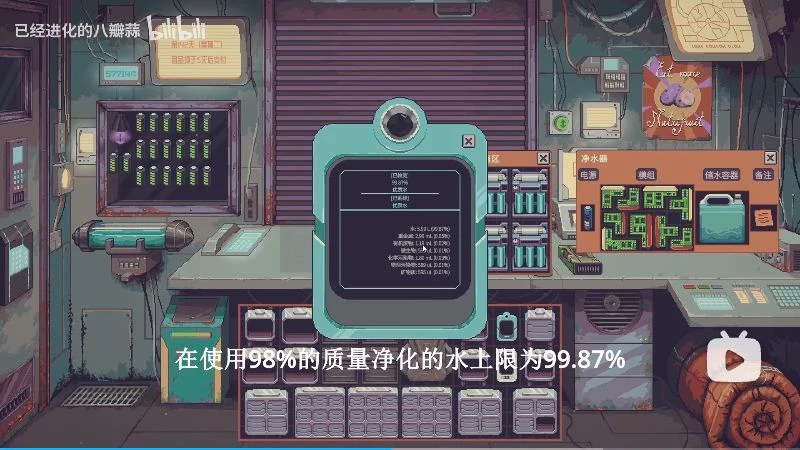
Purifier module slots beside an AquaScan reading. Chinese UI. Frame from
_章鱼冬冬包_’s Bilibili water-trading tutorial
, 02:13, published 2026-08-30.
Compare equipment values in the item and price reference. To build a run around water trading, read about the Water Merchant’s starting equipment and traits.
How much Quality does a Moisture Farm need for Pure Water?
In 1.0, a Moisture Farm produces Pure Water at a total Quality bonus of +150% or higher. This is the machine’s combined Quality bonus, separate from the purity percentage measured in a water test.
| Total Quality bonus | Water produced |
|---|---|
| 0% – +49% | Ghostwater |
| +50% – +99% | Basewater |
| +100% – +149% | High-Quality water |
| ≥ +150% | Pure Water |
After installing Quality modules, check the machine’s final bonus and output tooltip. Once the threshold is met, attach an empty container and a charged power source, then wait overnight. See the machine module guide for installation and removal.
The number of modules depends on their actual bonuses and other attributes. Use the final total shown by the machine. Efficiency changes power consumption and Performance changes water output; neither replaces the Quality requirement.
Working Moisture Farms share the shop’s air. Each farm’s output is divided by 1 + 0.25 × (working farms − 1): two working farms produce 80% each, three about 67% each and four about 57% each. Check the output tooltip before expanding; adding farms gives diminishing returns.
Is purer water always better?
For winemaking, High-Quality water and Pure Water both add 1 point; Basewater adds 0, and lower grades subtract points. With two handfuls of small berries and standard yeast, Basewater reaches the top grade. See the BloomBerry wine guide for recipes, scoring and the manual’s Pure Water advice.
For growing crops, watch the pollutants. The farming manual recommends low-pollutant water for most plants and explicitly excludes minerals from that category.
How do you add water trading to your current shop?
If you did not start as a Water Merchant, Joe Wild’s Water Trading referral has a base cost of 300 credits, gives a starter kit immediately and brings a water trader into your customer visits.
Before treating a batch for sale, compare its purchase price, treatment supplies used and final sale offer. Keep money for the next batch and rent. The money-making guide compares water with wine and rat ranching.
Which businesses can water trading supply?
The Water Merchant start supplies testing and purification tools directly; an existing shop can use Joe Wild’s referral. Both entrances use this page’s testing, treatment and sale workflow.
Reserve suitable water for wine or hydroponics to connect ingredient preparation within one shop. Check the next process’s water requirements before deciding how far to purify. The career Wiki maps the other connections.
See Water Merchant for the career’s starting resources and related contacts.
In-game manuals
Happy water: mixing, testing and returning customers
Read the test result before changing labels

Dex’s original playthrough screenshot · Simplified Chinese interface.
Dex’s result reads Detected: Basewater / Labeled: Basewater / 98.05%. Both grades agree. This is a water-test result, not evidence that a label was changed. The percentage is water’s share of the entire liquid mixture, truncated to two decimals; 98.999% is still 98.99%, below the next grade. Red labeling changes the claimed grade, not the mixture.
Use an unused test strip or your own AquaScan on the seller’s container before buying. Strips have base value 3 and are consumed once. Double-clicking a used strip reopens the original sample snapshot; it does not test water you later mixed or purified. The associated container’s current label may appear beside that old sample. Use a new strip after treatment. AquaScan (base 200) and the Chemical Spectrometer (base 400, water mode) read the current mixture, including its components, and refresh once per second. These scanners do not consume a battery or durability for the scan.
Confront appears for a seller’s nonempty, unexposed, mislabeled water when that trade permits confrontation. Match Label appears for your own nonempty, unexposed, mismatched water: it reveals the real grade and updates the claim; it does not purify anything. Two different purities inside the same grade still match. Below 35%, the mixture is outside the standard named-water range. Retest the final batch you actually intend to sell.
| Detected grade | Purity |
|---|---|
| Pure Water | 99.90–100% |
| High-Quality Water | 99.00–99.89% |
| Basewater | 98.00–98.99% |
| Ghostwater | 96.00–97.99% |
| Rustwater | 90.00–95.99% |
| Gutterflow | <90% |
Current purifier quality limits
The dedicated purifier’s base value is 250. Insert your water container, supply enough power for a cycle and sleep. It consumes 4kJ per working cycle; a cycle that removes nothing does not draw that charge. Performance changes the removal budget, Quality sets the ceiling below and Efficiency changes energy use. The base ceiling is 99.01%, with no special filter module required. Hover over the machine to read Max Purity, then scan the water after each night. See the batch-size examples to estimate how many nights you need.
Purification tablets first reduce chemical pollution above the mixture’s 0.7% floor, then use remaining effect on microbes. They do not remove heavy metals or organic waste. A plateau calls for a different treatment, not endless tablets. UV removes microbes; the portable purifier raises water to at least 98%, charging one durability per started 100 mL only if the whole batch can be processed. The moisture farm is a different machine: base value 350, base output 850 mL, pure water at +150% total quality. Do not apply its +150% threshold to this purifier.
| Total quality bonus | Maximum purity |
|---|---|
| <+15% | 99.01% |
| +15–24% | 99.16% |
| +25–49% | 99.36% |
| +50–74% | 99.65% |
| +75–99% | 99.80% |
| +100–199% | 99.90% |
| ≥+200% | 100.00% |
The purifier replaces removed non-water ingredients with water, keeping the total liquid volume. That includes removable drugs and alcohol. If you want to preserve an active ingredient, choose the treatment in chemical purification before putting that mixture into a water purifier.
Sell water after closing
To sell processed water after hours, use the Vending Fountain: fill the matching source slot, power the machine and collect the balance next morning. The guide covers tank labels, upgrades and nightly water volumes.
Older version notes
Demo 050-Rev5-L
Demo 050 allowed the UV Lamp in the pitcher’s filter slot. In 1.0, use it directly on the water container instead.
Related Articles
Wiki
Lou: toy box, Republic transmitter and difficulty-based demands
Return Lou's box, choose a gift, use the Republic transmitter and resolve her demands. Check difficulty amounts and payment thresholds.
Guides
Probably Stolen achievements: all 21 and unlock routes
All 21 Probably Stolen Steam achievements, with deed conditions, Clean Hands, Rat Wrangler, workshop goals, Steam counters and practical unlock routes.
Guides
Dream Dust and Nightmare Dust: mushrooms, extraction and sales
Grow or buy the right mushrooms, measure alcohol, extract at 45°C, dry and finish both dusts, then choose buyers and uses in Probably Stolen.
Was this helpful?
Thanks for the feedback!