
Probably Stolen reactor guide: charging, repairs and meltdown
Get the Makeshift Reactor, charge adjacent batteries and machines, plan nightly integrity loss, upgrade safely and dispose of radioactive waste.
1.0
Version history
- 1.0 Main guide
Added the complete reactor acquisition, charging, maintenance and safety workflow.
Prepare and obtain the reactor
Choose Makeshift Reactor at character creation: this neutral trait costs 1 point and starts you with a  Makeshift Micro Nuclear Reactor. It is available across professions. Reserve a 5 × 3 space, plus room for neighbouring batteries or machines; hover over the reactor to read integrity and upgrade count.
Prepare  Scrap Metal for repairs and
 Electronic Parts (Common) for upgrades. The Junker sells both. With tutorial customers retained, the day-2 seller carries 3 Scrap Metal and 1 common electronic part; Jackson’s introduction is scheduled for day 6. You can begin maintenance before meeting him.
If you have the trait and own no reactor anywhere, Dr. Jackson adds a replacement to regular and special stock. A reactor in a bag, hidden storage, the trash or outing inventory still counts. The starting unit has base value 0; a replacement has base value 150 credits, with the actual quote affected by trading modifiers. Monday Special Stock is not required.
Buy from Jackson when he visits, or visit his shop after introduction or Skip Intro, while Lower Levels access is available. Select the reactor, move it to the trading counter and confirm the purchase on the tablet. Purchased goods on his counter or ground return to your shop automatically: clear receiving space rather than packing the reactor into a backpack.
Place the reactor and install machine batteries
Leave the reactor directly in an inventory grid. It has no battery slot, fuel slot, contents window or power switch. Select repair or upgrade material and use it on the reactor itself; general machine modules and module-bay expansions do not apply.
| Placement | Result |
|---|---|
| Rechargeable cell sharing a horizontal or vertical edge in the same grid | Receives the reactor’s nightly charge |
| Compatible whole machine sharing that edge, with a cell in its battery slot | Its installed cell receives the charge |
Reactor and machine both inside the same  Machine Bay |
Works when their occupied cells share an edge |
| Reactor outside a bay or box, touching its outer shell | Does not reach machines or loose batteries inside |
| Diagonal corner, one-cell gap or two separate inventory windows | No adjacency |
| Several contact squares along one target | One charge per target, not per contact square |
The basic bay is 6 × 8, the expanded bay 11 × 14; both can fit the reactor, but the neighbouring equipment also needs space. Rotate held items with Q/E. A machine’s battery belongs in its power slot, not its materials storage. A loose battery beside the machine does not replace its installed cell.
The reactor has no power slot, so a Current Converter cannot be installed in it. Converters can still power other compatible machines, but their service keeps its own bill even when the reactor makes ordinary shop electricity free. For a machine needing 4 kJ nightly, an unupgraded converter costs 6 credits per night. A U=18 reactor can instead replenish 4 kJ in that machine’s adjacent installed rechargeable cell, covering its nightly use without converter service.
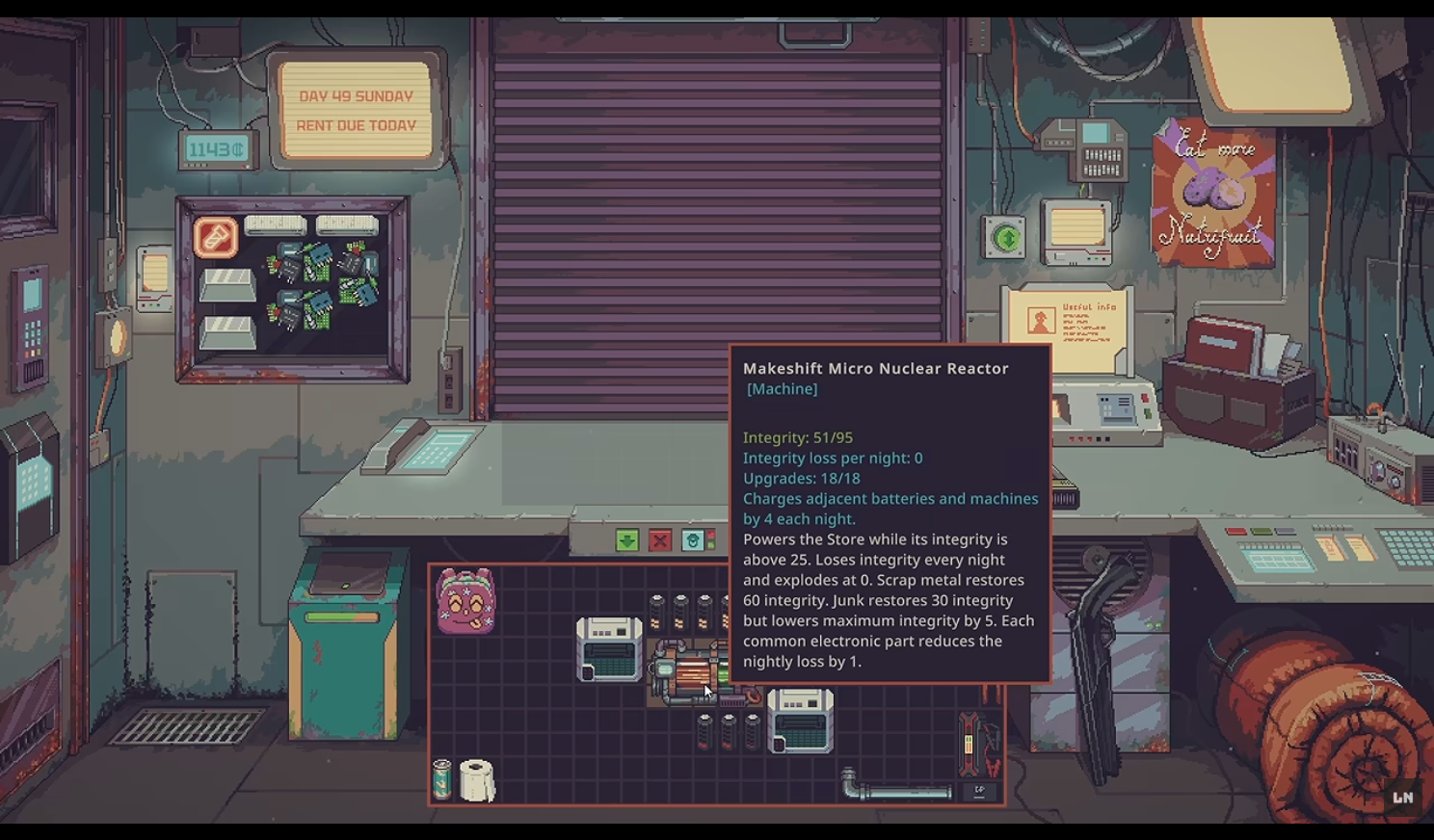
Nightly supply and compatible equipment
With this trait, a reactor above 25 integrity supplies shop electricity. Ordinary Power Service is disabled at zero cost; power-line hijacks and the commercial supply upgrade are unavailable. Station blackouts do not affect this trait. Machine operation still draws from each machine’s own battery.
| Upgrades U | Integrity lost each night d | Charge per adjacent target |
|---|---|---|
| 0–4 | 18–14 | 1 kJ |
| 5–9 | 13–9 | 2 kJ |
| 10–14 | 8–4 | 3 kJ |
| 15–17 | 3–1 | 4 kJ |
| 18 | 0 | 4 kJ |
Here U is the number of successful upgrades: d = max(0, 18 − U) and C = min(4, 1 + floor(U / 5)). Every adjacent target receives the full C, capped at its own capacity. At U=18, two eligible neighbours each receive 4 kJ, for 8 kJ combined. This is energy added per night, measured in kJ.
Chargeable cells are  Energy Cell (100 kJ),
 Energy Cell (Mk. II) (250 kJ) and
 Self Charging Energy Cell (100 kJ). The self-charging type also restores its own 4 kJ nightly; both gains share the capacity cap. Disposable Battery, Current Converter and Hypertech Power Cell cannot receive this recharge.
Supported battery-equipped machines include furnaces, hydroponics, DNA editors, 3D printers, alarms, Mirage Projectors, moisture collectors, water purifiers, Cryptographic Desequencers, water-bottle printers, evaporators, AgeWell, refrigerators, aquaculture systems and both vending-machine types. Battery-slot tools such as Aug Scanners and advanced or hypertech turbochargers also qualify if they fit and touch. Cleaning robots, hot plates, mixers and chemical molders do not use this charging path. A cell inside a Recharger does not receive the reactor’s charge through its casing.
Check integrity before sleeping
Wear happens before charging. Each night the reactor loses d integrity; shop power is recalculated, then adjacent cells charge only if the new integrity is greater than 25. Ordinary overnight machines work afterwards and can spend that new energy.
For a fresh 100/100, U=0 reactor that is never repaired, count nights experienced by that reactor:
| Nights elapsed | Integrity after wear | Charge per target | Result |
|---|---|---|---|
| 1 | 82 | 1 kJ | Shop powered |
| 2 | 64 | 1 kJ | Shop powered |
| 3 | 46 | 1 kJ | Orange integrity warning |
| 4 | 28 | 1 kJ | Shop powered |
| 5 | 10 | 0 | No power; next-night explosion warning |
| 6 | 0 | 0 | Meltdown the following morning |
For tonight’s power, sleep with I > d + 25. At U=0 this means at least 44 integrity: 43 falls to exactly 25 and stops supplying power. Avoiding an explosion alone requires I > d.
A bare water purifier consumes 4 kJ when it actually processes water. With U=18 and I=26, an adjacent empty 0/100 cell gains 4, the purifier spends 4, and the morning reading is 0 despite successful production. An unupgraded reactor’s 1 kJ cannot sustain that workload. At 99/100, a 4 kJ charge caps at 100 before consumption; overflow is lost.
Alarms also consume energy in the early-night phase, with no guaranteed order relative to the reactor or a self-charging cell. Give an alarm enough charge before sleeping; an empty cell beside a reactor is not a reliable same-night start. Rearranging items on screen does not establish an execution order.
Repair and upgrade
Select the material and use its target interaction on the reactor. Check current integrity I, maximum M and upgrades U afterwards.
| Material | Effect | Cost and limit |
|---|---|---|
| Scrap Metal |
Restore 60 integrity, capped at M | Consumes 1; requires I < M; maximum unchanged |
 Junk |
Lower M by 5, then restore 30 capped at the new M | Consumes 1; requires I < M; permanent maximum loss |
| Electronic Parts (Common) |
U+1; nightly wear falls by 1 | Usually consumes 1; maximum 18 upgrades; no integrity restored |
At 99/100, Junk produces 95/95, reducing current integrity. After 15 Junk repairs, the original maximum of 100 becomes 25, too low to power anything even when full. Scrap Metal cannot restore the lost maximum. Repairs are unavailable at full integrity; rare or hypertech electronic parts do not substitute for common parts here.
From U=0, reaching U=18 takes 18 successful upgrade actions. Tinkerer gives each upgrade a 20% chance to preserve its material; both repair materials are always consumed. Upgrade gains at 5, 10 and 15 raise charging to 2, 3 and 4 kJ.
Prefer Scrap Metal, stay above the pre-sleep threshold and upgrade as resources allow. At U=18, keep integrity above 25 for lasting supply. 25 integrity remains powerless; 0 still triggers meltdown next night, even with zero wear. Upgrading does not heal. A repair immediately refreshes shop power.
Handle waste and prevent meltdown
The reactor produces one  Radioactive Waste barrel per 160 actual integrity lost, carrying the remainder forward. With U=0 and repairs that keep the loss at 18 each night, night 9 reaches 162: one barrel, 2 progress left. An unrepaired starting reactor melts down after only 100 total loss and never reaches its first barrel. U=18 stops new waste progress; existing barrels and progress remain. Reserve 3 × 4 free squares for each expected barrel. Move accumulated barrels to free storage or your outing backpack to keep that space available.
Ordinary buyers refuse radioactive waste and trash collection skips it. Counter cleanup returns barrels the next morning. Carry them in your selected outing backpack to Dumping Grounds, put individual barrels directly on the ground and confirm departure. Georgio can return the first discarded batch once the story reaches day 3 or later; finish the encounter and discard the returned barrels again. Follow the waste-disposal steps. With Maimed, that destination is unavailable; the same disposal trip cannot be used.
Before sleeping, repair any reactor that would reach zero. A reactor keeps deteriorating below 26 and inside bags, hidden storage or the trash. Trash collection happens after reactor wear: binning a critical reactor and sleeping still sets the explosion that ends the run next morning. A healthy second reactor cannot cancel another reactor’s meltdown.
To replace one, finish transferring the old reactor out of your ownership before Jackson’s missing-reactor stock check. Moving it into another owned container does not qualify; the starting unit’s zero base value is not a promised 150-credit sale. Meltdown ends the game the following morning, with no continue-running-the-shop option.
For a completed disposal sale, wait for the ordinary Merchant, put the 5 × 3 reactor on the trading counter, include it in the sale and confirm on the tablet. The starting reactor can bring 0 credits; Jackson does not buy the whole reactor. Keep repairing it while waiting for a buyer. The machine-selling guide covers the trade.
Troubleshoot missing power
- No charge: check post-wear integrity first, then same-grid edge contact, the actual battery slot and the cell type.
- No morning gain: check whether the machine worked and spent energy, or the battery hit capacity before working.
- Shop dark after 18 upgrades: inspect integrity; repair above 25. The upgrade count alone does not restore supply.
- Alarm failed: charge it before bed rather than relying on the order of early-night charging.
- Replacement missing: search bags, hidden storage, trash and outing items for the old reactor; confirm that this run has the trait.
- More waste despite low usage: waste follows actual integrity loss. Upgrade wear to zero rather than reducing the number of neighbouring machines.
For other charging methods and battery capacities, use energy cells and charging.
Related Articles
Guides
Mods: install, activate, disable and remove
Install Workshop or local mods, activate them in the main menu, approve permissions and restart. Check dependencies, removal and official modding docs.
Guides
Cartel deliveries: quotas, counter space and leaving safely
Prepare weekly Dream Dust, check quantity and purity penalties, use both counters, and finish the Cartel reputation route to leave without ending your run.
Guides
Plant trait editing: remove, upgrade and check rank limits
Remove unwanted plant traits while keeping seeds, clear opposing traits, upgrade DNA disks and check rank limits, heat and inherited seeds.
Was this helpful?
Thanks for the feedback!